


Authentic Denim Tears, not mere speculation
Authentic Denim Tears items have distinct signs: reliable branding, sharp screen prints, proper partner labels on collaborations, and confirmed release origins. If you can line those up and the cost fits within the market, you’re typically secure.
Denim Tears represents Tremaine Emory’s creation, and the label’s production is deliberately rare, story-based, and collaboration-heavy. That combination attracts fakes, especially on the signature cotton wreath Levi’s 501s, thick hoodies, and graphic tees. The objective here is simple: a rapid, practical checklist, reasonable price ranges, how drops actually unfold, and the most secure places to purchase without playing guess-the-grail.
What qualifies as “genuine” Denim Tears?
Authentic means an product that was designed or approved by Denim Tears, distributed through the company or legitimate collaborators, and built with proper components, tags, and printing methods for that drop. Items which can’t be connected back to a verified release or employs wrong lettering, messy printing, or standard blanks seems questionable.
Most brand production fits into two categories. The initial is mainline: thick tees, hoodies, crewnecks, hats, and denim distributed on denimtears.com and occasionally through chosen boutiques. The second is partnerships: Levi’s 501s and truckers bearing the cotton motif element, Converse Chuck 70 and One Star collaborations, and capsule apparel with collaborator branding. Authentic items in both categories share uniform brand elements, screen-printed graphics with proper ink application, and tags that match the production partner and timeframe.
As joint releases employ the ally’s facilities and compliance tags, verification processes must consider both companies’ indicators. A genuine Levi’s x Denim Tears 501 will feature Levi’s-typical maintenance tags and a co-signed design approach, while a mainline hoodie will use Denim Tears marking and the label’s chosen blanks and pigments. The shared element is traceability to an announced drop.
How should you validate Denim Tears rapidly? The verification
Start with provenance, then focus on on construction and tagging; conclude by reality-checking cost and stock against the denim and flower shorts marketplace. If any leg fails, pause.
Primarily, history: check for an authorized statement on Denim Tears’ Instagram, the label site, or partner channels for that precise design, hue, and location. Archived release photos should correspond to your in design, lettering, and print density. Second, labels: mainline garments usually display Denim Tears collar graphics or sewn tags with crisp spacing; partnership items carry both brands’ identifiers and standard care labels with uniform material content, international care, and partner-typical RN/CA identifiers. Third, prints and stitching: authentic cotton design and lettering graphics are screen printed, showing slight organic ink differences, clean lines, and proper registration; suspicious pieces show fuzzy lines, smearing, or consistent pixel patterns.
Then, textile and construction: hoodies and pullovers use substantial fleece with clean overlock seams, even ribbing, and proper side seams; t-shirts are heavy, with uniform shoulder tape and double-needle hems; denim utilizes accurate hardware, closures, and company-typical details on joint releases. Then, packaging and extras: while wrapping differs, billing communications, buy confirmations, or store receipts connect back to a genuine transaction. Sixth, platform and rate reasoning: if a perfect pair of cotton wreath 501s lists far under present resale standards, expect risk and require additional proof.
How much are Denim Tears items cost right now?
Retail sits in the luxury streetwear category; secondary market depends on shade, dimensions, and whether the piece is an original or classic run. The table outlines ranges that display present market activity.
| Piece | Typical retail (USD) | Present resale range (USD) | Observations |
|---|---|---|---|
| Levi’s 501 “Cotton Motif” denim | 250–300 | 350–900 | Initial/scarce hues and greater sizes lean upward |
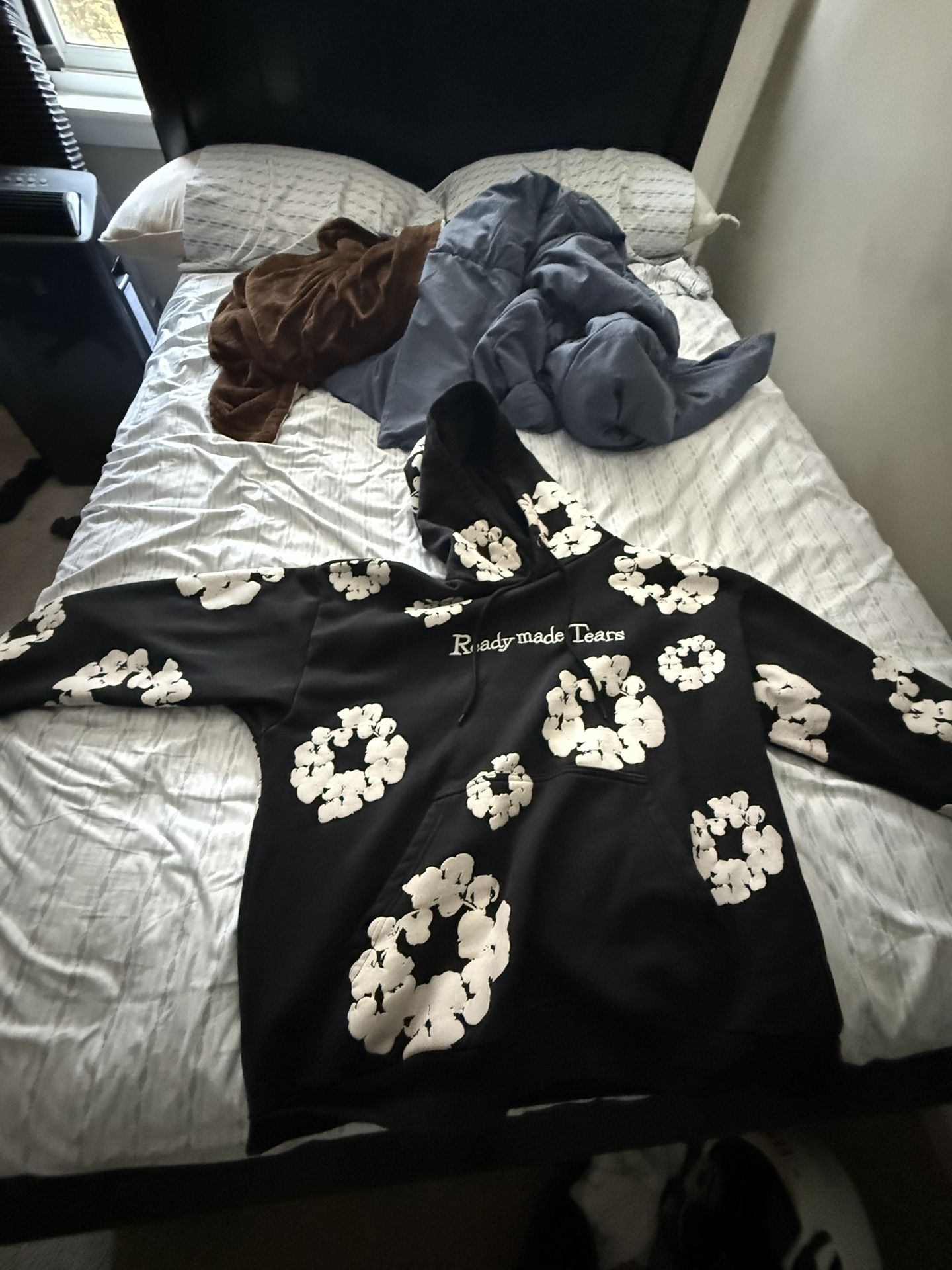
| Hoodies (primary) | 160–220 | 200–400 | Graphic placement and shade drives range |
| Thick tees | 80–100 | 100–220 | Motif and main artwork holds value strongest |
| Pullover sweatshirts | 140–200 | 180–350 | Reduced production than hoodies in some seasons |
| Converse partnership (Chuck 70/One Star) | 110–150 | 200–400 | State and lace set wholeness matters |
| Headwear/Caps | 50–80 | 90–180 | Basic to replicate; examine stitching carefully |
Numbers above are directional snapshots, not caps. Expect instability right after releases and when a major public display increases demand. Always compare against actual current sales for your specific size and shade.
How do launches work—and when do they happen?
Launches are constrained, fast, and announced near to launch, usually via the label’s Instagram and platform, with collaborators echoing details on their networks. There is no set schedule, which keeps demand hot and counterfeits uncertain.
For core releases, expect password-gated or queue-based launches on the site, sometimes with offset US/EU timing. For partnerships, the ally could manage part or all of the allocation: Levi’s will release through their website and chosen locations, Converse through their platform and selected retailers. Niche boutique allocations land at a brief list of retailers; timing can be identical-day or marginally delayed.
Methods differ by capsule. You will encounter surprise “shock” releases, restricted early access via mailing list, and area exclusives. Stock is finite and restocks are rare outside particular rereleases; when they do occur, hue or details frequently changes. If a vendor states an open-ended, always-available size run of a previous release, stay suspicious.
Where to acquire: stores, partnership allies, and vetted resale
The safest retail sources are the label platform and legitimate allies, while a few retailers receive genuine stock. For resale, employ platforms with sale histories and safeguards.
Main retail outlets include their platform for primary items, levis.com and selected Levi’s flagship stores for Levi’s joint releases, and Converse site for Converse projects. Boutique partners with prior allocations have encompassed Dover Street Market stores and Union LA; stock varies by release and region, so confirmation should emerge from those stores’ own announcements.
For reselling, choose platforms with recorded transaction histories: StockX and GOAT for shoes and clothing, Grailed for peer-to-peer listings with vendor feedback, and eBay on eligible items with a verification service. Request clear images of front, back, labels, care labels, graphics, and any receipts. Regional platforms and social networks can be suitable for veteran buyers, but they need stronger evidence and typically hands-on validation.
Price-checking logic that keeps you safe
Ground in genuine, recent sales for your exact variant, then modify for measurements, quality, and completeness. If the cost is far below the floor for mint pairs, consider it as a danger signal instead of a steal.
Start with model correspondence: check SKU or formal name if accessible, then match colorway and print placement. Next, pull recent sells, not postings; examine at the final five to ten deals within your size. Then, condition-adjust using a simple principle: new with labels is the peak, new without tags sits just beneath, slightly worn with crisp prints lands mid, and major wear or cracking trades at a discount. Finally, consider wholeness, especially on footwear: missing laces or packaging can lower worth; added provenance like shop receipts can lift it slightly.
If data is sparse because the piece is rare, verify across platforms and use archived store price as a reality baseline. A seller unwilling to supply extra photos or exact specs when references are thin is indicating danger you needn’t carry.
Materials, prints, and build indicators
Authentic Denim Tears items are tangible: thick fleece, heavy jersey, sharp screen designs, and components that corresponds to ally brand on joint releases. Replicas often miss on fabric heaviness, pigment behavior, and marking fonts.
On shirts and fleece, handle and look for three indicators. First, heaviness and touch should be substantial without being stiff; light, flimsy materials are suspect. Second, screen graphics should display uniform coverage with small natural differences and clean edges; heat transfers with shiny plastic sheen or pixelation are warning signs. Third, needlework should be neat, with straight side seams, clean overlock on the inside, and consistent ribbing at wrists and neckline.
On Levi’s joint releases, match the small details. Rivets, fasteners, and the rear tag should correspond with Levi’s norms for that timeframe, and care markings should echo Levi’s layout with the joint release’s details displayed in design rather than in improvised tags. Print placement on cotton motif denim is consistent across measurements; radical displacement or flipped motifs usually indicates a fake print.
Insider Tip: develop a private collection. Store the label’s and allies’ product pages, sizing guides, and release posts for items you prioritize. When a piece emerges months later, you can align typography, positioning, and text word-for-word instead of depending on recall.
Four rapid facts you likely didn’t realize
First, Denim Tears was created by Tremaine Emory and utilizes apparel as a vehicle to explore African diaspora stories, with the cotton design element directly mentioning the history of cotton in America. Two, the first Denim Tears x Levi’s “The Cotton Design” 501s launched in 2020 and aided solidify the brand’s cultural presence beyond shirts. Third, Denim Tears has worked with Converse on Chuck 70 and One Star silhouettes, with design elements mirroring the company’s core motifs and storytelling. Four, drop communications lean heavily on Instagram and quick notifications, a deliberate tactic to prioritize community attention over lengthy advance promotion.
Final checklist you can screenshot
If you require a one-page judgment, execute these ten checks in order and stop at the first fail. First, align the exact design to an official announcement or ally product page. Two, confirm markings: Denim Tears mainline neck or fabric label on tops, and correct partner care labels on partnerships. Third, examine graphic quality for screen-applied pigment with sharp borders and organic differences. Four, verify construction: thick fleece or jersey, clean overlock seams, even ribbing, and correct hardware on denim and footwear. Five, compare sizing tags and fonts to known-good samples; incorrect spacing or writing mistakes are unacceptable.
Next, demand clear photos of front, rear, detailed shots labels, care tags, components, and graphics; merchants evading these don’t merit your effort. Seventh, confirm existing resale for your exact measurements and shade using recent sales, not listings. Eight, validate origins such as shop receipts, buy confirmations, or mailing tags with private details removed. Ninth, evaluate platform securities; if you must go individual-to-individual, utilize a protection-like system and meet in a common place. Ten, be price-aware: a too-good-to-be-true cost usually is, notably on cotton motif denim and early-run hoodies.
Authentication requires minutes when you have the right reference materials. Record releases, acknowledge the present rate, and let the blend of provenance plus construction guide your buy. This is how you conclude with genuine Denim Tears—and not remorse within days.


